
Learning tablets, Bluetooth earbuds, power tools, small appliances with batteries — many of the enquiries we have handled recently come down to one line: "We can't ship it from China. Can you?"
Why is shipping battery goods by air directly from mainland China getting harder?
This is what we see in the enquiries we handle, not one regulation applied across the board: battery goods exported by air from mainland airports usually need a separate air transport condition assessment; routes and space that accept battery cargo are limited; and many mainland shipping channels refuse anything with a battery outright. The result: shippers with complete product documents still struggle to find a route that will accept them.
Hong Kong airport has more routes and more airlines, and battery cargo declared and packed under the international dangerous goods rules moves through mature channels. That is why more shippers and overseas forwarders truck the goods into Hong Kong first and export from there.
What counts as battery goods? UN3480, UN3481 and UN3091 in one table
| Lithium-ion batteries on their own (including power banks) UN3480 | Forbidden on passenger aircraft, cargo aircraft only; state of charge must be 30% or less. Our advice: ask per shipment — never assume it can go |
|---|---|
| Battery inside the product (earbuds, learning tablets, watches) UN3481 | The most common category. 30% state of charge is recommended, not yet mandatory. Our advice: the easiest to handle — have the UN38.3 ready |
| Battery packed separately in the same box (e.g. power tool with spare battery) UN3481 | From 2026 the battery must be at 30% state of charge or less. Our advice: set the charge at the factory |
| Lithium metal batteries (e.g. coin cells) UN3090 / UN3091 | Separate rules, based on lithium content. Our advice: give us the exact battery model and ask |
Source: IATA lithium battery guidance (2026). The current dangerous goods regulations and the accepting airline have the final say.
New for 2026: batteries packed with equipment must be at 30% charge or less
From 1 January 2026, the international air rules turned the 30% limit for lithium-ion batteries packed with equipment (UN3481, Packing Instruction 966) from a recommendation into a requirement: no more than 30% of rated capacity. For batteries contained in equipment (PI 967), 30% remains a recommendation; batteries shipped on their own (UN3480) have had to be at 30% or less for years.
Our advice: do not leave it until handover. Set the charge before the goods leave the factory and state it on the invoice or cargo details — far cheaper than a rejection at the airport.
Shenzhen handover, Hong Kong departure: which part do we handle?
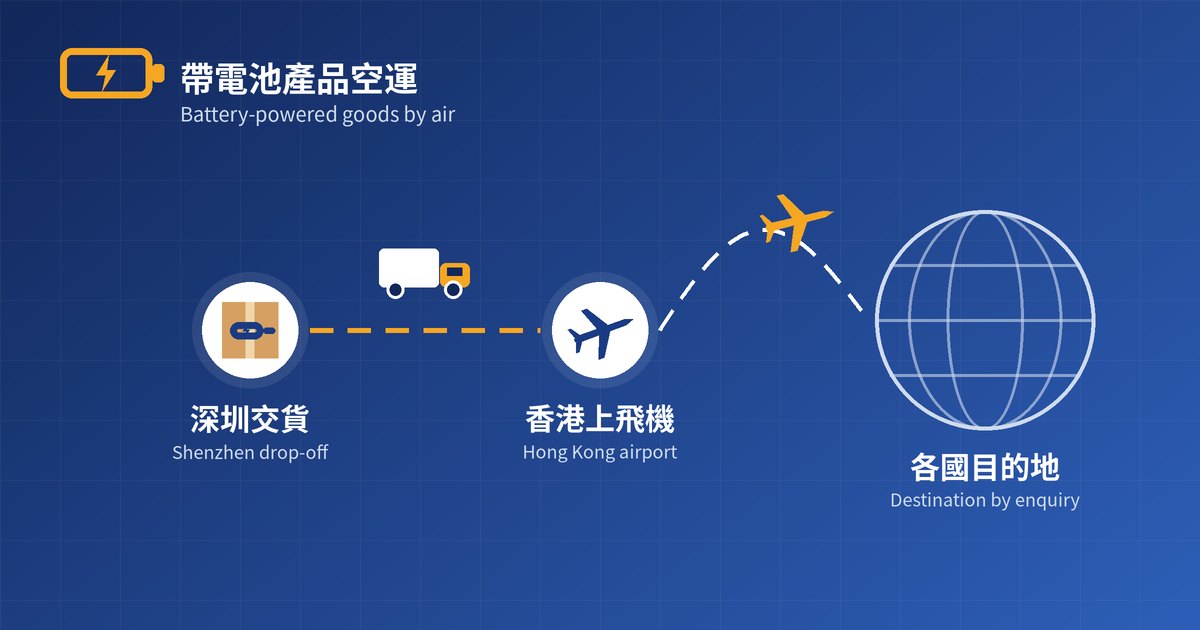
To be clear about our role: we are the bridge from mainland China to Hong Kong. You hand the goods to us in Shenzhen, we move them across the border to Hong Kong, and they connect to Hong Kong air freight for the country you name. It suits two kinds of customer:
- Mainland shippers with overseas buyers and battery goods that cannot find a direct route out
- Overseas forwarders with Chinese suppliers' battery goods who want a reliable export point
- Send us product details on WhatsApp or WeChat: description, battery type, Wh (or lithium content), pieces, weight, destination
- We check with the airline for that destination and tell you whether it can go and which documents are needed
- Once documents are complete, we arrange the Shenzhen handover
- The goods cross into Hong Kong and are handed over for export as the airline requires
- They fly from Hong Kong to your agent or consignee at destination
Destinations are confirmed per shipment. Countries and airlines differ on battery cargo, so we will never just say "anywhere is fine".
Which documents do you need to ship battery goods?
Requirements depend on the airline, and the accepting airline has the final say. These are the ones we are asked about most:
| UN38.3 test summary | Every lithium battery should have one from the factory. The rules require manufacturers and distributors to make it available on request |
|---|---|
| MSDS / SDS | The battery safety data sheet, which many airlines want to see |
| Battery specifications | Wh for lithium-ion, lithium content for lithium metal; number of pieces and batteries per piece |
| Other | Some airlines have extra requirements (such as a drop test), confirmed per shipment |
Our advice: send the UN38.3 and MSDS before we start talking. With the documents in hand, answers usually come quickly.
Three routes, and how we see them
| Ship directly from the mainland | If you have a reliable channel and full documents, keep using it. If not, do not force it — the time lost to rejections and held cargo often costs more than the freight |
|---|---|
| Hand over in Shenzhen, export from Hong Kong | Our recommendation when there is no route from the mainland, or you want a steady export point. We handle the Shenzhen to Hong Kong leg |
| Ship as general cargo without declaring the battery | We do not do it and do not recommend anyone does. Airports screen, and the consequences of being caught far outweigh the saving |
What we will not do
- Hide batteries or declare battery goods as general cargo
- Accept lithium battery products without a UN38.3 test summary
- Say "yes, it can go" before checking with the airline
This is our judgement, not regulation text: with battery goods, the expensive part is not the freight — it is rejections and held cargo.
Sending battery products from Hong Kong to New Zealand?
If you are sending learning tablets, earbuds or similar battery-powered electronics from Hong Kong to New Zealand, we run a separate Hong Kong to New Zealand courier line: products whose brand has UN38.3 can go without removing the battery; standalone power banks cannot. See Hong Kong to New Zealand.
Battery goods waiting to ship?
Send the description, battery type, Wh, pieces, weight and destination, with the UN38.3 and MSDS if you have them. We check with the airline first, then tell you whether we can take it.
WhatsApp us the details WeChat Our Tsuen Wan warehouseFrequently asked questions
What can I do if battery goods cannot be air-freighted from mainland China?
Consider exporting from Hong Kong instead. Forever Gain takes the goods in Shenzhen, moves them across the border to Hong Kong and connects them to Hong Kong air freight; destination and document requirements are confirmed per shipment.
Which countries can you ship to?
We handle the Shenzhen to Hong Kong leg. Destinations from Hong Kong depend on the airline and the type of goods, and are confirmed per shipment — we do not promise everywhere.
Which documents are needed to ship battery goods by air?
Usually a UN38.3 test summary, an MSDS/SDS and the battery specifications; some airlines have additional requirements, and the accepting airline has the final say.
Can standalone batteries or power banks be shipped?
Standalone lithium-ion batteries (UN3480) are forbidden on passenger aircraft and can only go on cargo aircraft, and acceptance varies by airline, so it must be checked per shipment.
What changed for lithium batteries by air in 2026?
From 1 January 2026, lithium-ion batteries packed with equipment (UN3481, Packing Instruction 966) must be shipped at no more than 30% state of charge. For batteries contained in equipment, 30% remains a recommendation.
Can battery goods be shipped as general cargo without declaring the battery?
No, and we will not do it. Concealing dangerous goods breaches air transport rules and can lead to rejection, seizure and penalties.